

Sample Scan
Syria — a readiness baseline for crisis finance flow
Public-evidence scan of the full fiscal system and flow factors.
Syria was selected because the country is emerging from prolonged conflict and a period of limited international engagement. Recent developments, including a $20 million PFM reform grant from the World Bank announced in March 2026, make it a relevant case for examining how the fiscal system is functioning as the country works to strengthen capacity. Public data on the fiscal system is also limited and fragmented, and the Fiscal Hydraulics method is designed to produce bounded findings in data-constrained environments.
The diagnostic traces flow across the core fiscal pipeline, emergency liquidity channels, and last-mile delivery, assessing what is evidenced, what appears limited, and where evidence remains inconclusive.
System map
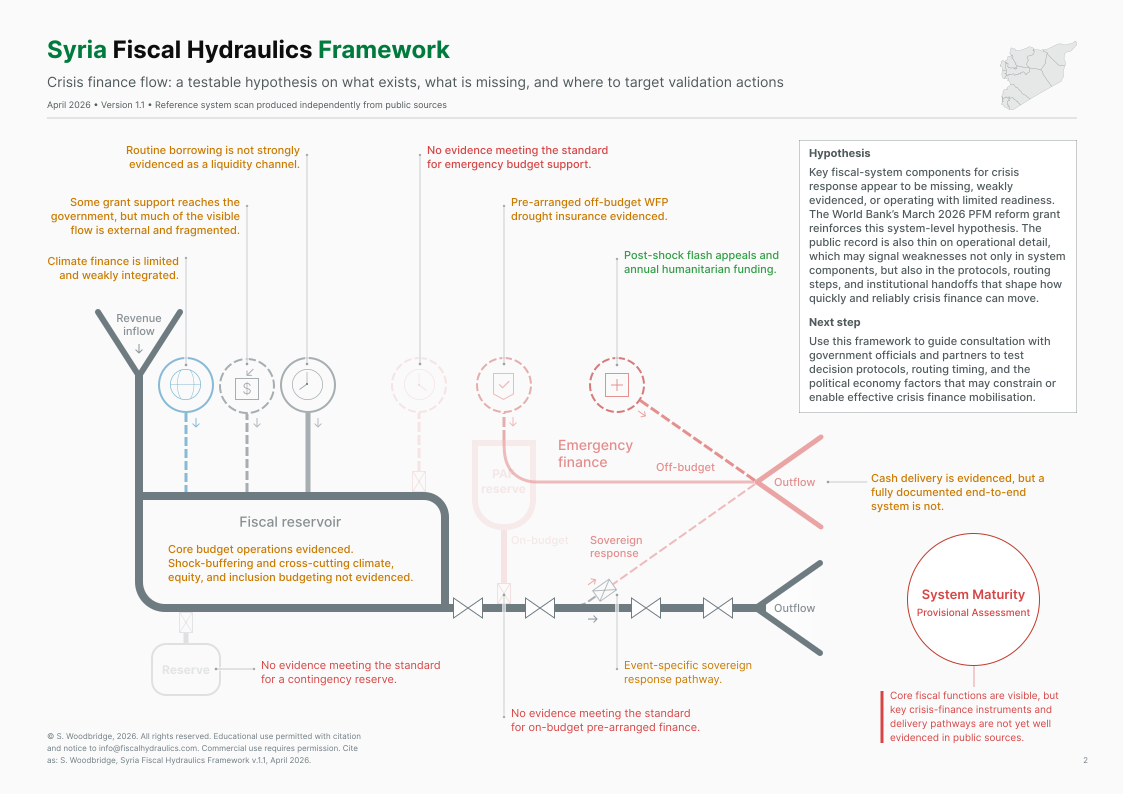
Where constraints may arise in Syria's crisis-finance flow — and what needs to be tested next. Green signals evidenced components; amber signals limited or partial evidence; red signals components not sufficiently evidenced in the public set.
Scope and diagnostic question
Diagnostic question
Where is the crisis-finance pathway most constrained in Syria, and what evidence is needed to confirm whether observed constraints reflect genuine readiness gaps, weak public documentation, or both?
Scope boundary
Mode: Readiness
Segments: Trunk / Channels / Distribution
Evidence base: Arabic and English public sources, with targeted human validation
Timing: Public evidence available as of April 2026
Segments: Trunk / Channels / Distribution
Evidence base: Arabic and English public sources, with targeted human validation
Timing: Public evidence available as of April 2026
Provisional System maturity level
1
Emerging
System maturity
Level 1 of 5 — Limited public evidence of shock-readiness
Some fiscal, payment, and delivery components are visible, but evidence gaps remain substantial and core crisis-finance functions are not yet evidenced in the public record as a coherent, shock-ready system.
Low confidence on sovereign routing
Moderate confidence on delivery layer
Payment and cash functions partially evidenced
Constraint hypothesis
Trigger
Track · Binding
Transit
The binding constraint is most likely upstream in the sovereign emergency finance pathway — at mobilisation, release, and routing through government systems.
Public evidence is stronger on external and humanitarian channels, and on some payment and cash-delivery functions, than on the on-budget instruments, protocols, and treasury rules needed for rapid sovereign crisis-finance flow.
Most constrained flow-chain factor: pathway readiness and authority to move funds — no evidence meeting the standard was identified for a contingency reserve, standing emergency budget support, or on-budget pre-arranged emergency finance, and the public record is thin on emergency release rules, handoff timing, and national-to-subnational routing.
Evidence gaps
Contingency reserve and standing emergency buffer — no public evidence meeting the standard was identified for a dedicated contingency reserve or standing contingency appropriation, limiting confidence that the core fiscal reservoir can absorb shocks quickly through sovereign mechanisms.
Emergency release protocols and routing rules — the public record is thin on decision protocols, release authority, commitment shortcuts, and timed handoffs, so rapid sovereign mobilisation cannot be confirmed from available sources.
End-to-end government cash-delivery architecture — cash delivery is evidenced, but a fully documented end-to-end system is not. Formal shock scale-up rules, provider agreements, and integrated social data architecture remain insufficiently evidenced in the public set.
Recommended actions
1
Immediate
Validate upstream sovereign finance mechanisms
Request evidence on any contingency line, reserve arrangement, emergency budget support mechanism, or treasury release protocol. This is the highest-priority step because the strongest current hypothesis is that sovereign mobilisation is the most constrained part of the system.
2
Immediate
Test routing and authority through official consultation
Use targeted consultation with Syrian officials and partners to confirm decision protocols, routing timing, and national-to-subnational handoffs. This should also test whether thin public evidence reflects limited transparency or genuine operational constraint.
3
Near-term
Distinguish sovereign flow from external and humanitarian flow
Map where humanitarian and off-budget channels are more operational than sovereign channels, and identify which components could realistically be brought closer to on-budget, rule-based crisis-finance delivery over time.
See how the diagnostic works in detail, or explore the products available for commissioning.