

Diagnosing where public resources stall — and what unlocks delivery to projects and communities
Fiscal Hydraulics helps you understand whether public finance can move through the system under pressure.
Existing tools assess institutional readiness and instrument design. They do not test whether finance can flow at crisis speed. Fiscal Hydraulics is for decision-makers who need to know whether committed finance can actually move.
Strong PFM assessments and well-designed instruments do not guarantee delivery when a shock hits.
PEFA and DRR-PFM assess institutional readiness and PFM system quality.
Instrument design focuses on triggers, payout speed, and coverage.
Fiscal Hydraulics addresses the question both leave open: where public finance is likely to stall between approval and delivery.
Three stages. One binding constraint.
Fiscal Hydraulics treats crisis response as a resource-flow problem: identifying where finance is delayed or blocked before it reaches projects and communities. The diagnostic tests three stages of movement — activation, pathway, and execution — to identify the most likely binding constraint.
- Contingency conditions met
- Financing instruments activated
- Disbursement authority granted
- Approval and release steps
- Treasury, budget, and control points
- On-budget and off-budget pathways
- Line ministry and local execution capacity
- Transfer pathways across levels
- Delivery constraints at the last mile
When the question is whether resources can actually move
Fiscal Hydraulics is used when the key issue is not only how much financing exists, but whether it can move through real systems quickly enough to reach projects and communities under pressure.
Assess whether crisis finance is likely to stall before stress conditions hit.
Test whether a financing pathway will work in practice across approvals, controls, and execution steps.
Identify where an instrument, programme, or response pathway may break down before assumptions are locked in.
Start with the level of evidence you need
Use a Scan for a rapid first view, a Diagnostic when stronger evidence is needed, and a Workshop when ownership, assumptions, or coordination are the constraint.
A fast, public-source read of likely flow constraints and evidence gaps. Best when you need a quick first view of where resources are likely to stall before commissioning deeper work.
View System ScanBuilds on the Scan with document verification and an evidence register. Best when decisions require stronger evidence, clearer validation, and a defensible basis for action.
View System DiagnosticA structured session to test the pathway hypothesis, surface contested assumptions, and align agencies around where the real bottleneck sits and what evidence is needed next.
View Map WorkshopA constraint hypothesis and the evidence to support it
A key output is the constraint hypothesis: where the system is likely to bind, how confident that assessment is, and what evidence would change it.
- A working hypothesis on the main binding bottleneck across activation, pathway, and last-mile execution
- A confidence-bounded assessment showing what the evidence supports and where gaps remain
- A proof pack showing the minimum evidence needed to confirm, revise, or challenge the diagnosis
- A view ready to support reform sequencing, technical assistance, programme design, or delivery support
- For the System Diagnostic: a formal evidence register with source citations and tier tagging
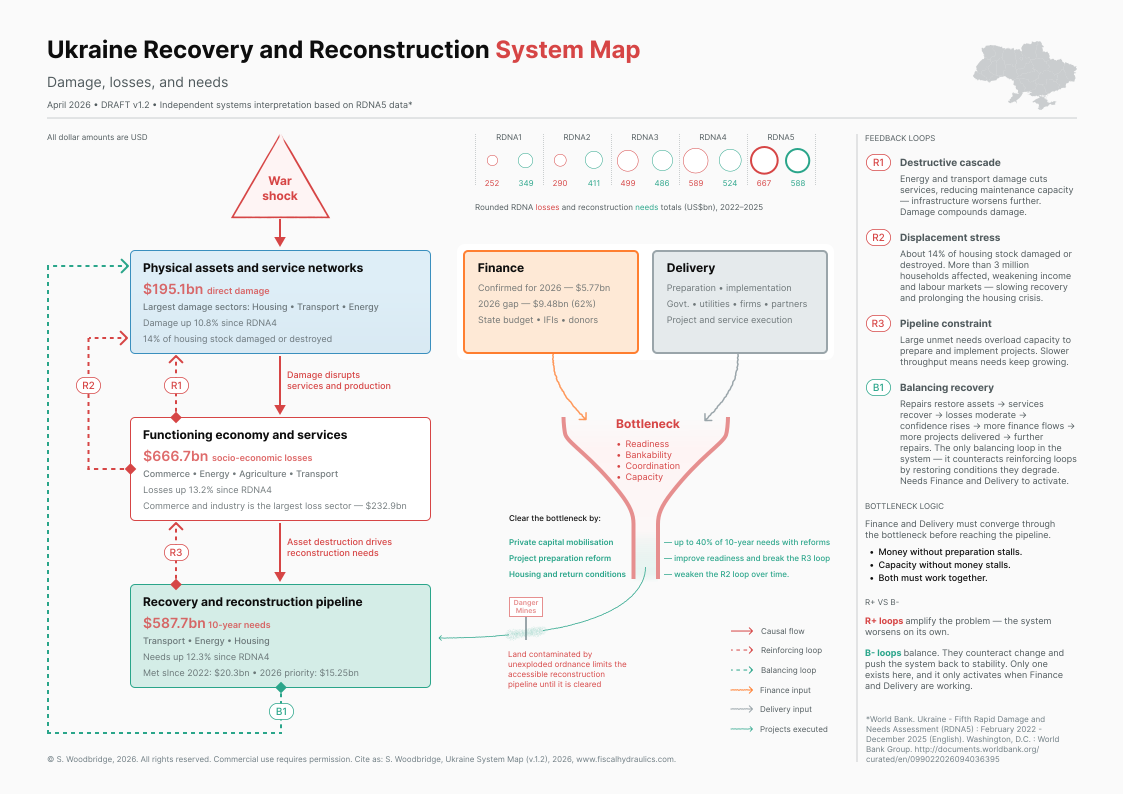
Tracing where reconstruction stalls
See how Fiscal Hydraulics maps where reconstruction stalls across finance, readiness, coordination, and delivery. This example shows how system bottlenecks can be visualised, tested, and turned into clearer action.
View the pageFlow maturity survey
Ten questions for a provisional read of where crisis finance is most likely to stall — useful as a first orientation before a Scan or deeper review.
Take the surveyHow work usually begins
Most engagements begin with a light scoping step, then narrow quickly toward the pathway, evidence level, and form of support that fits the decision in front of you.
- 1 Short scoping conversation
- 2 Agree the pathway or decision question
- 3 Confirm the right starting product
- 4 Deliver the diagnostic output
- 5 Decide whether deeper validation or follow-on support is needed
Describe the decision you're working on
If something on this page fits a decision in front of you and you'd like to know more, describe the context and any questions below and click the submit button for a response within 48 hours.