

Diagnosing where public resources stall — and what unlocks delivery to projects and communities
Fiscal Hydraulics helps governments, donors, and partners identify where crisis and reconstruction finance is likely to slow, stop, or fail in real systems — and what needs to change so resources can move through to implementation and support at community level.
For organisations working to move resources through real systems under pressure.
Focus on flow
Fiscal Hydraulics treats crisis response as a resource-flow problem: where financing is delayed, diverted, or blocked before it reaches projects and communities. The diagnostic tests three stages of movement — activation, pathway, and execution — to identify the most likely binding constraint.
- Contingency conditions met
- Financing instruments activated
- Disbursement authority granted
- Approval and release steps
- Treasury, budget, and control points
- On-budget and off-budget pathways
- Line ministry and local execution capacity
- Transfer pathways across levels
- Delivery constraints at the last mile
Use Fiscal Hydraulics when the question is whether resources can actually move
Fiscal Hydraulics is used where the key problem is not only how much financing exists, but whether it can move through real systems quickly enough to support projects and communities under pressure.
Assess whether crisis finance is ready to move before stress conditions hit — identifying where delivery is likely to stall before it becomes failure.
Test whether a financing pathway can flow through the delivery system in practice — not just on paper, but through the real approvals, controls, and execution steps involved.
Identify where an instrument, programme, or response pathway may slow, stop, or fail before assumptions are locked in and communities remain exposed.
Start with the level of evidence you need
Use a Scan for a rapid first view, a Diagnostic when evidence needs to be stronger, and a Workshop when pathway ownership, assumptions, or coordination are the bottleneck.
A fast, public-source read of likely flow constraints and evidence gaps. Best when you need a quick first view of where resources are likely to stall before commissioning deeper work.
View System ScanBuilds on the Scan with document verification and an evidence register. Best when decisions require stronger evidence, clearer validation, and a defensible basis for action.
View System DiagnosticA structured session to test the pathway hypothesis, surface contested assumptions, and align agencies around where the real bottleneck sits and what evidence is needed next.
View Map WorkshopA practical view of where flow is breaking down
Fiscal Hydraulics provides a structured view of where resources are likely to stall, what the most likely binding constraint is, and what evidence is needed to confirm or revise the diagnosis.
- A system-level view of where throughput is constrained and why
- A mapped fiscal pathway showing where resources are most likely to slow, stop, or fail before reaching delivery
- A working hypothesis on the most likely binding bottleneck across trunk, channels, and last-mile execution
- A proof pack showing the minimum evidence needed to confirm, revise, or challenge the diagnosis
- Explicit evidence gaps flagged with implications for confidence and decision-making
- A confidence-bounded view ready to support reform sequencing, technical assistance, programme design, or delivery support
- For the System Diagnostic: a formal evidence register with source citations and tier tagging
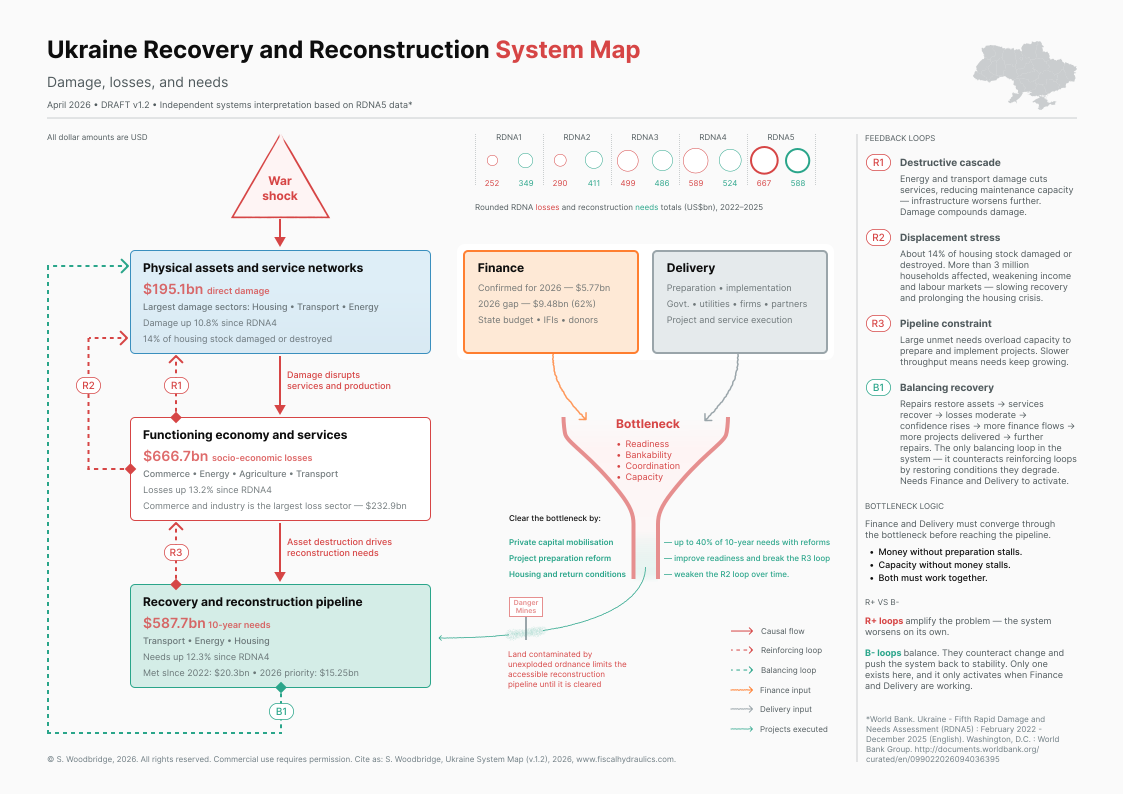
How reconstruction stalls
An example of how Fiscal Hydraulics can diagnose where reconstruction slows: across finance, readiness, coordination, and delivery — and how those system effects can be visualised and tested.
View the pageFlow maturity survey
Ten questions for a provisional read of where a crisis finance system sits on the flow maturity scale — with a suggested next step based on where the system stands.
Take the surveyStart with where resources are most likely to stall
Begin with a rapid first view of where flow is breaking down, then go deeper where stronger evidence, validation, or coordination support is needed.